दिन 45: Pipelines, Cross-Validation और Tuning
✅ आज आप सीखेंगे
- Pipelines: preprocessing + model एक object में
- एक train/test split क्यों काफ़ी नहीं
- k-fold और stratified cross-validation
- Grid और randomised hyper-parameter search
- Train → validate → final test, सही क्रम
🏢 असली दुनिया में
आपका loan model एक split पर 0.83 accuracy और दूसरे पर 0.79 देता है। सच कौन सा? और production server पर ले जाते समय कोई inputs scale करना भूल जाता है और हर prediction ग़लत हो जाती है। Pipelines और cross-validation दोनों समस्याएँ हल करते हैं – यही notebook experiment और production model का फ़र्क है।
Pipelines
import pandas as pd
from sklearn.compose import ColumnTransformer
from sklearn.preprocessing import OneHotEncoder, StandardScaler
from sklearn.impute import SimpleImputer
from sklearn.pipeline import Pipeline, make_pipeline
l = pd.read_csv("loan_applications.csv")
l["lti"] = l["loan_amount"] / (l["monthly_income"] * 12)
num = ["monthly_income", "credit_score", "loan_amount", "years_employed", "lti"]
cat = ["employment"]
X, y = l[num + cat], l["approved"]
pre = ColumnTransformer([("num", make_pipeline(SimpleImputer(strategy="median"), StandardScaler()), num),
                         ("cat", OneHotEncoder(handle_unknown="ignore"), cat)])
from sklearn.model_selection import train_test_split
from sklearn.linear_model import LogisticRegression
model = Pipeline([("prep", pre), ("clf", LogisticRegression(max_iter=2000))])
X_tr, X_te, y_tr, y_te = train_test_split(X, y, test_size=0.2, random_state=42, stratify=y)
model.fit(X_tr, y_tr)
print("test accuracy:", round(model.score(X_te, y_te), 3))
new = pd.DataFrame([{"monthly_income": 52000, "credit_score": 745, "loan_amount": 600000,
                     "years_employed": 4, "lti": 600000 / (52000 * 12), "employment": "Salaried"}])
print("P(approve) for a raw new row:", round(model.predict_proba(new)[0, 1], 3))Scaler और encoder हर बार सिर्फ़ training हिस्से पर fit होते हैं – कोई leakage नहीं। नया raw data सीधे अंदर जाता है। और पूरा object deployment (Day 50) के लिए एक file में save होता है।
एक split क़िस्मत है
import pandas as pd
from sklearn.compose import ColumnTransformer
from sklearn.preprocessing import OneHotEncoder, StandardScaler
from sklearn.impute import SimpleImputer
from sklearn.pipeline import Pipeline, make_pipeline
l = pd.read_csv("loan_applications.csv")
l["lti"] = l["loan_amount"] / (l["monthly_income"] * 12)
num = ["monthly_income", "credit_score", "loan_amount", "years_employed", "lti"]
cat = ["employment"]
X, y = l[num + cat], l["approved"]
pre = ColumnTransformer([("num", make_pipeline(SimpleImputer(strategy="median"), StandardScaler()), num),
                         ("cat", OneHotEncoder(handle_unknown="ignore"), cat)])
from sklearn.model_selection import train_test_split
from sklearn.linear_model import LogisticRegression
scores = []
for seed in range(10):
    a, b, c, d = train_test_split(X, y, test_size=0.2, random_state=seed, stratify=y)
    scores.append(Pipeline([("prep", pre), ("clf", LogisticRegression(max_iter=2000))]).fit(a, c).score(b, d))
print("10 different splits:", [round(s, 3) for s in scores])
print(f"range {min(scores):.3f} – {max(scores):.3f}")k-fold cross-validation
import pandas as pd
from sklearn.compose import ColumnTransformer
from sklearn.preprocessing import OneHotEncoder, StandardScaler
from sklearn.impute import SimpleImputer
from sklearn.pipeline import Pipeline, make_pipeline
l = pd.read_csv("loan_applications.csv")
l["lti"] = l["loan_amount"] / (l["monthly_income"] * 12)
num = ["monthly_income", "credit_score", "loan_amount", "years_employed", "lti"]
cat = ["employment"]
X, y = l[num + cat], l["approved"]
pre = ColumnTransformer([("num", make_pipeline(SimpleImputer(strategy="median"), StandardScaler()), num),
                         ("cat", OneHotEncoder(handle_unknown="ignore"), cat)])
from sklearn.model_selection import cross_val_score, StratifiedKFold, cross_validate
from sklearn.linear_model import LogisticRegression
from sklearn.ensemble import RandomForestClassifier, HistGradientBoostingClassifier
cv = StratifiedKFold(n_splits=5, shuffle=True, random_state=0)
models = {"logistic": LogisticRegression(max_iter=2000),
          "random forest": RandomForestClassifier(n_estimators=300, min_samples_leaf=3, random_state=0, n_jobs=-1),
          "boosting": HistGradientBoostingClassifier(learning_rate=0.05, max_iter=200, random_state=0)}
for name, clf in models.items():
    res = cross_validate(Pipeline([("prep", pre), ("clf", clf)]), X, y, cv=cv, scoring=["accuracy", "roc_auc", "f1"])
    print(f"{name:14s} acc {res['test_accuracy'].mean():.3f} ± {res['test_accuracy'].std():.3f} | "
f"AUC {res['test_roc_auc'].mean():.3f} | F1 {res['test_f1'].mean():.3f}")0.83 ± 0.02 जैसा CV score business को अपेक्षित performance और उसकी स्थिरता दोनों बताता है। जिन दो models की ranges overlap करें वे लगभग बराबर हैं – सरल वाला चुनें।
Hyper-parameter tuning
import pandas as pd
from sklearn.compose import ColumnTransformer
from sklearn.preprocessing import OneHotEncoder, StandardScaler
from sklearn.impute import SimpleImputer
from sklearn.pipeline import Pipeline, make_pipeline
l = pd.read_csv("loan_applications.csv")
l["lti"] = l["loan_amount"] / (l["monthly_income"] * 12)
num = ["monthly_income", "credit_score", "loan_amount", "years_employed", "lti"]
cat = ["employment"]
X, y = l[num + cat], l["approved"]
pre = ColumnTransformer([("num", make_pipeline(SimpleImputer(strategy="median"), StandardScaler()), num),
                         ("cat", OneHotEncoder(handle_unknown="ignore"), cat)])
from sklearn.model_selection import GridSearchCV, StratifiedKFold
from sklearn.ensemble import RandomForestClassifier
pipe = Pipeline([("prep", pre), ("clf", RandomForestClassifier(random_state=0, n_jobs=-1))])
grid = {"clf__n_estimators": [200], "clf__max_depth": [4, 8, None], "clf__min_samples_leaf": [1, 5, 20]}
gs = GridSearchCV(pipe, grid, cv=StratifiedKFold(5, shuffle=True, random_state=0), scoring="roc_auc", n_jobs=-1).fit(X, y)
print("best params:", gs.best_params_)
print("best CV AUC:", round(gs.best_score_, 3))
res = pd.DataFrame(gs.cv_results_)[["param_clf__max_depth", "param_clf__min_samples_leaf", "mean_test_score"]]
res["param_clf__max_depth"] = res["param_clf__max_depth"].astype(object).where(res["param_clf__max_depth"].notna(), "None").astype(str)
print(res.pivot(index="param_clf__max_depth", columns="param_clf__min_samples_leaf", values="mean_test_score").round(3))Pipeline के अंदर parameters का नाम step__parameter होता है: clf__max_depth मतलब “clf नाम के step का max_depth”। Preprocessing भी tune कर सकते हैं: prep__num__simpleimputer__strategy।
import pandas as pd
from sklearn.compose import ColumnTransformer
from sklearn.preprocessing import OneHotEncoder, StandardScaler
from sklearn.impute import SimpleImputer
from sklearn.pipeline import Pipeline, make_pipeline
l = pd.read_csv("loan_applications.csv")
l["lti"] = l["loan_amount"] / (l["monthly_income"] * 12)
num = ["monthly_income", "credit_score", "loan_amount", "years_employed", "lti"]
cat = ["employment"]
X, y = l[num + cat], l["approved"]
pre = ColumnTransformer([("num", make_pipeline(SimpleImputer(strategy="median"), StandardScaler()), num),
                         ("cat", OneHotEncoder(handle_unknown="ignore"), cat)])
from scipy.stats import loguniform, randint
from sklearn.model_selection import RandomizedSearchCV, StratifiedKFold
from sklearn.ensemble import HistGradientBoostingClassifier
pipe = Pipeline([("prep", pre), ("clf", HistGradientBoostingClassifier(random_state=0))])
space = {"clf__learning_rate": loguniform(0.01, 0.3), "clf__max_leaf_nodes": randint(8, 64),
         "clf__min_samples_leaf": randint(5, 60), "clf__max_iter": randint(100, 500)}
rs = RandomizedSearchCV(pipe, space, n_iter=25, cv=StratifiedKFold(5, shuffle=True, random_state=0),
                        scoring="roc_auc", random_state=0, n_jobs=-1).fit(X, y)
print("best CV AUC:", round(rs.best_score_, 3))
print({k.replace("clf__", ""): (float(round(v, 3)) if isinstance(v, float) else int(v)) for k, v in rs.best_params_.items()})GridSearchCV
- हर combination आज़माता है
- 2–3 parameters, कम values के लिए अच्छा
- Cost गुणा में बढ़ती है
RandomizedSearchCV
- n_iter random combinations लेता है
- कई parameters / ranges के लिए बेहतर
- अच्छी settings कहीं जल्दी ढूँढता है
Professional protocol
- 1आख़िरी test set (20%) अलग करके बंद रखें
- 2बचे 80% पर: CV से models की तुलना
- 3सबसे अच्छे 1–2 को CV search से tune
- 4चुनी pipeline को पूरे 80% पर फिर fit
- 5बंद test set पर एक बार score करके report
import pandas as pd
from sklearn.compose import ColumnTransformer
from sklearn.preprocessing import OneHotEncoder, StandardScaler
from sklearn.impute import SimpleImputer
from sklearn.pipeline import Pipeline, make_pipeline
l = pd.read_csv("loan_applications.csv")
l["lti"] = l["loan_amount"] / (l["monthly_income"] * 12)
num = ["monthly_income", "credit_score", "loan_amount", "years_employed", "lti"]
cat = ["employment"]
X, y = l[num + cat], l["approved"]
pre = ColumnTransformer([("num", make_pipeline(SimpleImputer(strategy="median"), StandardScaler()), num),
                         ("cat", OneHotEncoder(handle_unknown="ignore"), cat)])
from sklearn.model_selection import train_test_split, GridSearchCV, StratifiedKFold
from sklearn.linear_model import LogisticRegression
from sklearn.metrics import roc_auc_score, classification_report
X_dev, X_test, y_dev, y_test = train_test_split(X, y, test_size=0.2, random_state=7, stratify=y)
pipe = Pipeline([("prep", pre), ("clf", LogisticRegression(max_iter=2000))])
gs = GridSearchCV(pipe, {"clf__C": [0.001, 0.01, 0.1, 1, 10]}, cv=StratifiedKFold(5, shuffle=True, random_state=0), scoring="roc_auc").fit(X_dev, y_dev)
final = gs.best_estimator_                                  # refit on all dev data automatically
p = final.predict_proba(X_test)[:, 1]
print("chosen C:", gs.best_params_["clf__C"], "| CV AUC:", round(gs.best_score_, 3), "| final TEST AUC:", round(roc_auc_score(y_test, p), 3))
print(classification_report(y_test, p > 0.5, digits=3))Learning curve: क्या ज़्यादा data मदद करेगा?
import pandas as pd
from sklearn.compose import ColumnTransformer
from sklearn.preprocessing import OneHotEncoder, StandardScaler
from sklearn.impute import SimpleImputer
from sklearn.pipeline import Pipeline, make_pipeline
l = pd.read_csv("loan_applications.csv")
l["lti"] = l["loan_amount"] / (l["monthly_income"] * 12)
num = ["monthly_income", "credit_score", "loan_amount", "years_employed", "lti"]
cat = ["employment"]
X, y = l[num + cat], l["approved"]
pre = ColumnTransformer([("num", make_pipeline(SimpleImputer(strategy="median"), StandardScaler()), num),
                         ("cat", OneHotEncoder(handle_unknown="ignore"), cat)])
import numpy as np
import matplotlib.pyplot as plt
from sklearn.model_selection import learning_curve, StratifiedKFold
from sklearn.ensemble import RandomForestClassifier
pipe = Pipeline([("prep", pre), ("clf", RandomForestClassifier(n_estimators=200, min_samples_leaf=5, random_state=0, n_jobs=-1))])
sizes, tr, va = learning_curve(pipe, X, y, cv=StratifiedKFold(5, shuffle=True, random_state=0), scoring="roc_auc",
                               train_sizes=np.linspace(0.1, 1.0, 8), n_jobs=-1)
plt.figure(figsize=(8.5, 3.8))
plt.plot(sizes, tr.mean(1), marker="o", label="training", color="#94a3b8")
plt.plot(sizes, va.mean(1), marker="o", label="cross-validation", color="#4f46e5")
plt.fill_between(sizes, va.mean(1) - va.std(1), va.mean(1) + va.std(1), alpha=0.2, color="#4f46e5")
plt.xlabel("training rows"); plt.ylabel("AUC"); plt.legend(); plt.title("Validation AUC is still rising → more data would help a little")
plt.show()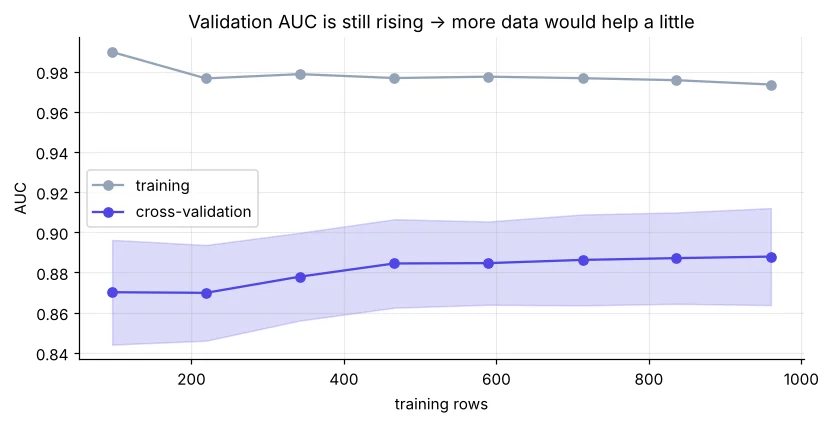
🏅 आज के Job Skills
Practice tasks
🏋️ Practice – ख़ुद करें
Solution देखें
import pandas as pd
from sklearn.compose import ColumnTransformer
from sklearn.preprocessing import StandardScaler, OneHotEncoder
from sklearn.pipeline import Pipeline
from sklearn.linear_model import Ridge
from sklearn.model_selection import cross_val_score
h = pd.read_csv("house_prices.csv")
num = ["area_sqft", "bedrooms", "bathrooms", "age_years", "metro_km"]; cat = ["city", "furnishing", "parking"]
pipe = Pipeline([("prep", ColumnTransformer([("n", StandardScaler(), num), ("c", OneHotEncoder(handle_unknown="ignore"), cat)])), ("m", Ridge(alpha=1))])
s = -cross_val_score(pipe, h[num + cat], h["price_lakh"], cv=5, scoring="neg_mean_absolute_error")
print(f"CV MAE ₹{s.mean():.2f} ± {s.std():.2f} lakh")n_neighbors (3–51) GridSearchCV से tune करें। सबसे अच्छा k?Solution देखें
import pandas as pd
from sklearn.compose import ColumnTransformer
from sklearn.preprocessing import OneHotEncoder, StandardScaler
from sklearn.impute import SimpleImputer
from sklearn.pipeline import Pipeline, make_pipeline
l = pd.read_csv("loan_applications.csv")
l["lti"] = l["loan_amount"] / (l["monthly_income"] * 12)
num = ["monthly_income", "credit_score", "loan_amount", "years_employed", "lti"]
cat = ["employment"]
X, y = l[num + cat], l["approved"]
pre = ColumnTransformer([("num", make_pipeline(SimpleImputer(strategy="median"), StandardScaler()), num),
                         ("cat", OneHotEncoder(handle_unknown="ignore"), cat)])
from sklearn.neighbors import KNeighborsClassifier
from sklearn.model_selection import GridSearchCV
gs = GridSearchCV(Pipeline([("prep", pre), ("knn", KNeighborsClassifier())]), {"knn__n_neighbors": list(range(5, 160, 10))}, cv=5, scoring="roc_auc").fit(X, y)
print(gs.best_params_, round(gs.best_score_, 3))Quick quiz
🧠 Quick Quiz – ख़ुद को जाँचें
Interview corner
💼 Interview Corner
Cross-validation क्या है और क्यों?
Data को k folds में बाँटकर k−1 पर train और बचे एक पर validate, k बार घुमाकर। यह एक split से ज़्यादा भरोसेमंद अनुमान (mean ± std) देता है और सारा data training व validation दोनों में इस्तेमाल होता है।
Leakage के बिना hyper-parameters कैसे tune करेंगे?
पहले test set अलग करें; बचे data पर stratified CV के साथ Pipeline पर GridSearchCV/RandomizedSearchCV चलाएँ; सबसे अच्छी pipeline फिर fit करें; test set पर एक बार evaluate करें। Time series में TimeSeriesSplit लें।
सारांश
- Pipeline + ColumnTransformer = leak-free, deploy करने लायक models।
- Stratified k-fold CV mean ± std देता है, एक क़िस्मत वाला number नहीं।
- छोटे grids के लिए GridSearchCV, बड़े spaces के लिए RandomizedSearchCV।
- Test set बंद रखें, CV से tune करें, एक बार test करें।
Day 46: unsupervised learning – K-Means clustering से customer segments ढूँढें।
