📝 Unit 4 Board Questions + Practice
2026-27 syllabus में Unit 4 के 10 marks हैं। Part A में 12 नए practice questions answers के साथ हैं (पहले ख़ुद हल करें, फिर "Answer देखें" दबाएँ)। Part B में पिछले CBSE board papers (2023, 2024, 2025, 2026) के Unit 4 के सभी 27 questions original रूप में हैं – tables, code और internal choice सहित, हर एक के answer के साथ। Questions board paper की तरह English में हैं।
1) पहले unit के lessons पढ़ें। 2) Part A notebook में हल करें, फिर answers मिलाएँ। 3) Part B को paper-wise timer लगाकर हल करें – लगभग 1.5 minute प्रति mark। 4) गलत हुए questions पर निशान लगाएँ और उस lesson को दोबारा पढ़ें।
Part A – Practice questions (answers के साथ)
A message pretends to be from a bank and requests credentials through a fake link. Identify the cybercrime.
Answer देखें
Phishing.
Which IPR generally protects a brand logo: patent, trademark or copyright? Select the most appropriate protection for brand identification.
Answer देखें
Trademark.
True or false: software available free of cost is necessarily open source.
Answer देखें
False. Access and reuse rights depend on its licence; zero price does not imply open source.
Differentiate active and passive digital footprints with one example each.
Answer देखें
Active: deliberate sharing, e.g. a public post. Passive: collected while using a service, e.g. browsing logs/tracking data.
Explain plagiarism. State how a student can avoid it in a school project.
Answer देखें
Presenting another person's work/ideas as one's own. Cite sources, identify quotations and create original analysis; also obtain permission/licences when required.
Give two netiquettes for a school discussion group.
Answer देखें
Use respectful language and protect others' personal information; other valid responsible practices accepted.
A student receives repeated humiliating posts. Identify the issue and suggest two actions that help protect the student.
Answer देखें
Cyberbullying; preserve evidence and report/block the account; tell a trusted adult or school authority.
Explain free and open source software. Give one benefit and two examples.
Answer देखें
Software licensed to allow use, study, modification and redistribution under its terms. Benefit: source inspection/adaptation. Examples: LibreOffice and GNU/Linux.
A school replaces 20 computers. Give one environmental hazard of improper disposal and two responsible management actions.
Answer देखें
Hazardous materials may contaminate soil/water. Reuse/refurbish suitable equipment and send unusable equipment to an authorised e-waste recycler; protect/erase stored data before transfer.
Name two health concerns associated with excessive technology use and suggest one practical habit that reduces risk.
Answer देखें
Examples: eye strain and posture-related discomfort. Take regular breaks and maintain suitable posture/workstation setup.
A learner receives a prize SMS linking to a page asking for a password and OTP. (i) Name the attack. (ii) Give two precautions. (iii) Name the Indian Act included in the syllabus that addresses cyber offences and electronic transactions.
Answer देखें
Phishing; do not share passwords/OTPs, verify through an independently accessed official channel; Information Technology Act, 2000. This is a syllabus-level identification question, not legal advice.
A student copies a photo without checking its licence and removes the creator's name. Explain (i) the attribution/plagiarism concern, (ii) the copyright/licensing concern, (iii) why credit alone may not grant reuse permission, (iv) one way to reuse legally.
Answer देखें
Removing credit can misrepresent authorship; copying may breach copyright or licence conditions. Attribution is not automatically permission. Obtain permission or use an appropriately licensed work and satisfy its terms, e.g. CC BY attribution requirements.
Part B – पिछले वर्षों के board questions (Unit 4)
CBSE Board Paper 2026 – 6 questions
Answer देखें
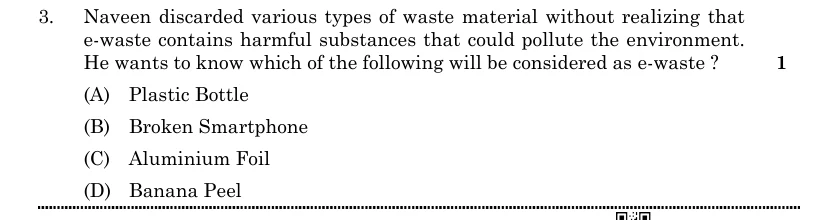
(B) Broken Smartphone
Answer देखें
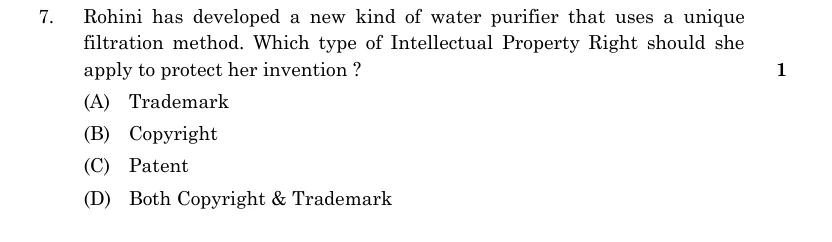
(C) Patent

Answer देखें
(C) Not using copyrighted materials without permission of the owner.
Answer देखें
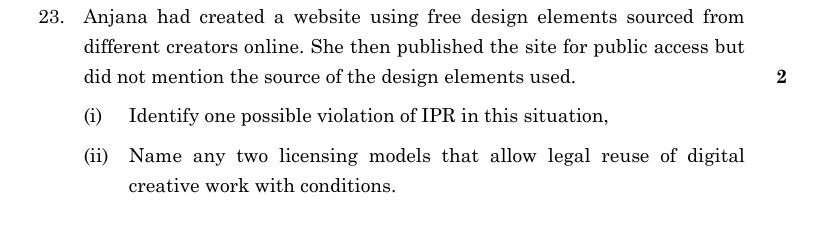
(i) Plagiarism / violation of licence terms – the creators' work was used without giving credit (attribution). (ii) Creative Commons (CC) licences and GNU GPL (also Apache licence).

Answer देखें
(a) Data protection means keeping personal and sensitive data safe from unauthorised access, misuse, loss or theft, using security measures and laws/policies (e.g. passwords, encryption, privacy rules).
(b) Any two: use strong passwords and two-factor authentication; do not share OTP/passwords; do not click unknown links or attachments; keep software and antivirus updated; use only secure (https) websites.
Answer देखें
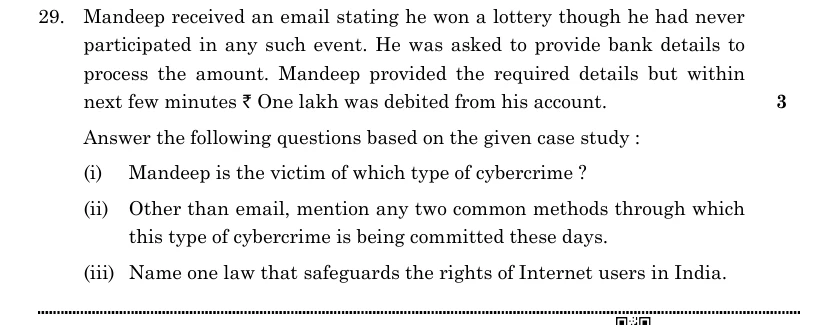
(i) Phishing (online financial fraud). (ii) Any two: SMS (smishing), phone calls (vishing), fake websites/links, social-media messages, WhatsApp messages, fake QR codes. (iii) The Information Technology Act, 2000 (IT Act).
CBSE Board Paper 2025 – 6 questions
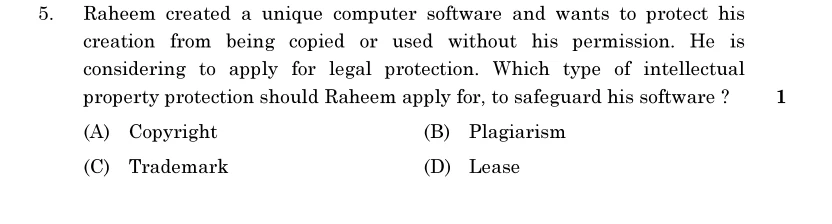
Answer देखें
(A) Copyright
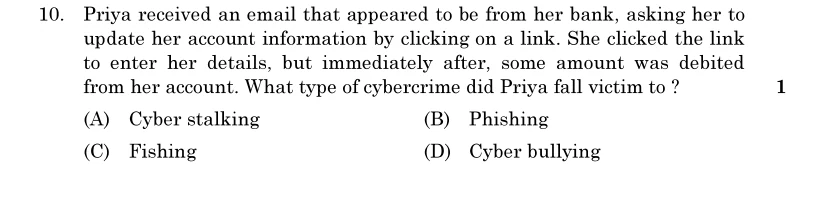
Answer देखें
(B) Phishing

Answer देखें
(B) Eye strain and other health issues
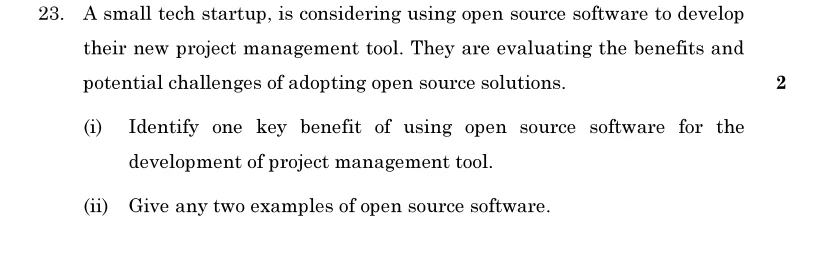
Answer देखें
(i) It is free to use and its source code can be studied and modified to suit the tool's needs (low cost, community support). (ii) Examples: Linux, LibreOffice, Mozilla Firefox, Python, MySQL, GIMP.

Answer देखें
Any two: toxic substances (lead, mercury, cadmium) leak into the soil and contaminate groundwater; burning e-waste releases poisonous gases that pollute the air; it harms plants, animals and human health; it wastes valuable metals that could be recycled.
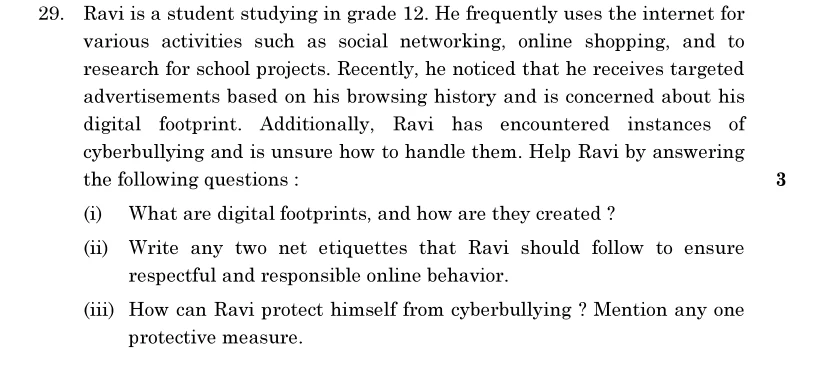
Answer देखें
(i) A digital footprint is the trail of data a person leaves while using the Internet. It is created actively (posts, comments, e-mails we choose to share) and passively (browsing history, cookies, location and searches collected by websites).
(ii) Any two: be polite and respectful; do not share others' personal information or photos without permission; do not spread fake news; respect copyright and give credit.
(iii) Do not reply to the bully; block and report the account; keep screenshots as evidence; tell parents/teachers; keep profiles private.
CBSE Board Paper 2024 – 8 questions
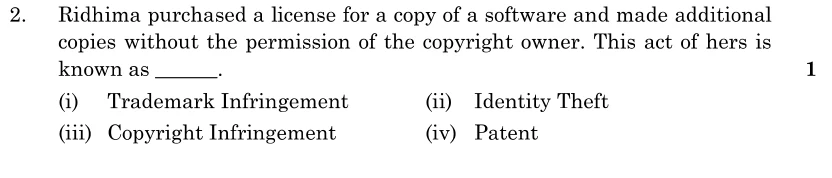
Answer देखें
(iii) Copyright Infringement
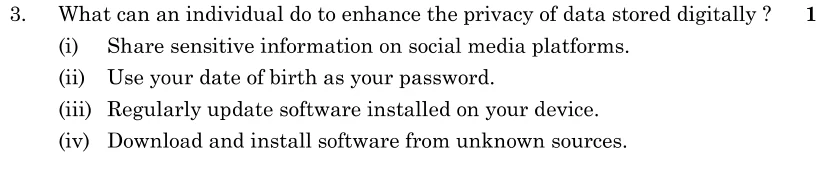
Answer देखें
(iii) Regularly update software installed on your device.

Answer देखें
(iii) Hacking

Answer देखें
(iv) Digital Footprint
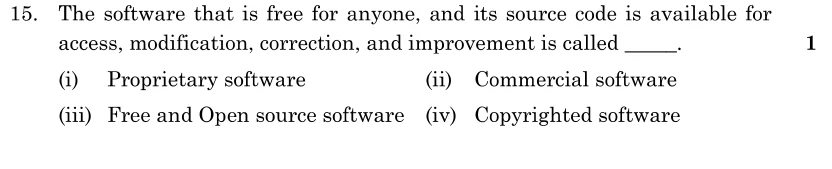
Answer देखें
(iii) Free and Open source software
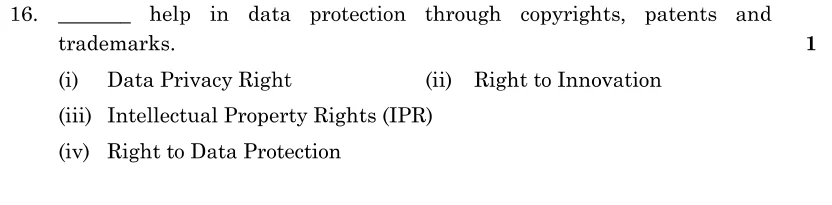
Answer देखें
(iii) Intellectual Property Rights (IPR)
Answer देखें
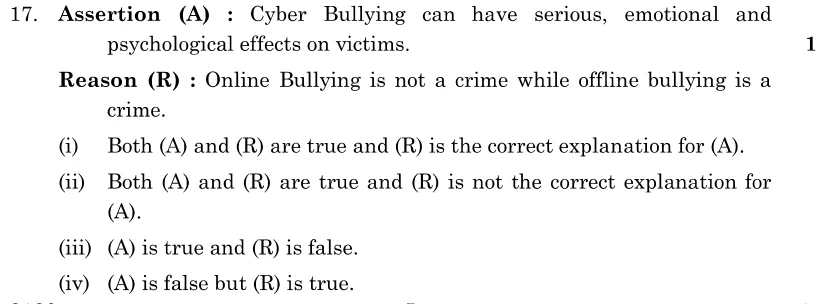
(iii) – Assertion is true, Reason is false: cyber bullying is also an offence (punishable under the IT Act and other laws).
Answer देखें
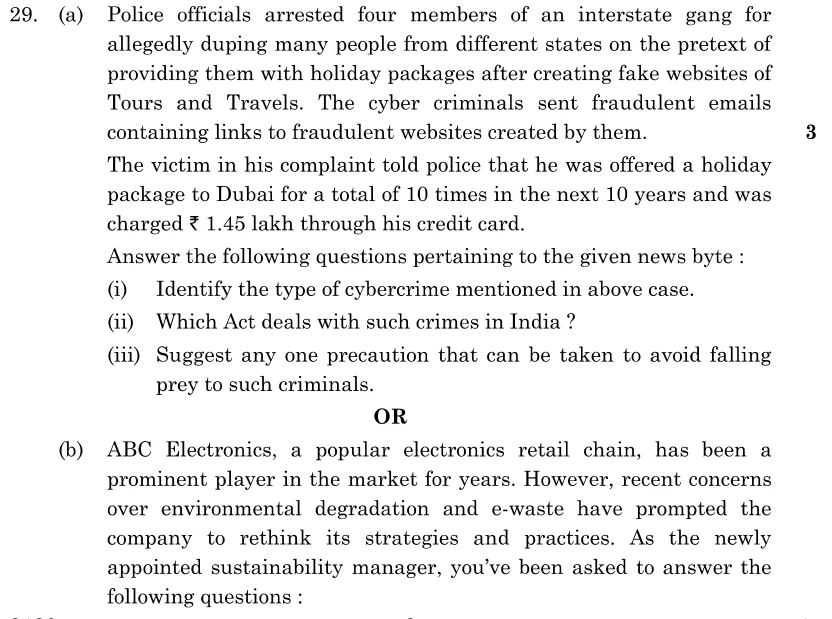
(a) (i) Phishing / online fraud (fake websites and fraudulent e-mails to cheat people). (ii) The Information Technology Act, 2000 (IT Act). (iii) Do not click links in unknown e-mails; check the website address (https and correct spelling) and book only through official/verified sites; never share card details or OTP.
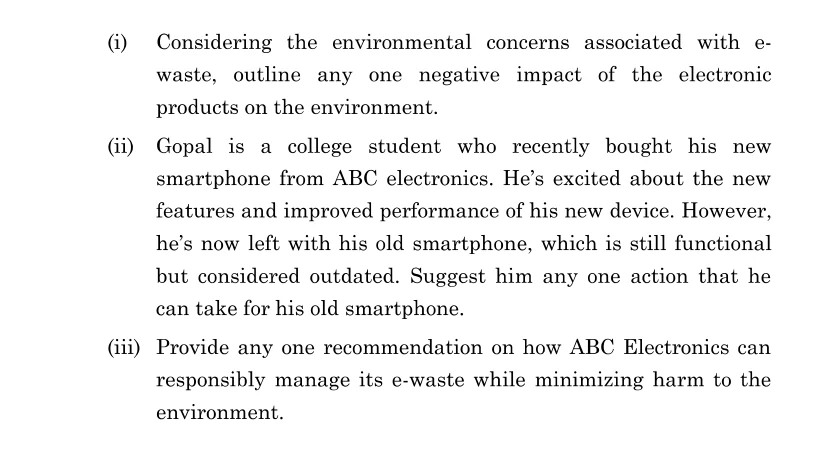
OR (b) (i) E-waste contains toxic metals like lead, mercury and cadmium which leak into soil and water when dumped, and burning it pollutes the air. (ii) Donate it, resell it, exchange it, or give it to an authorised e-waste collection/recycling centre. (iii) Start a take-back/buy-back scheme for old devices and send them only to authorised e-waste recyclers (reduce, reuse, recycle).
CBSE Board Paper 2023 – 7 questions
Answer देखें
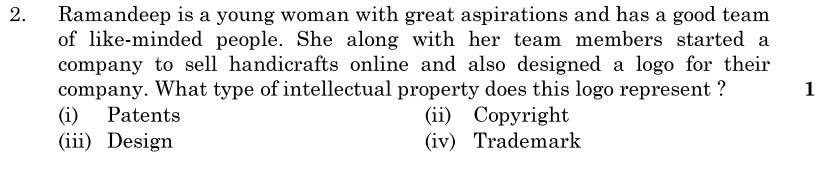
(iv) Trademark

Answer देखें
(iii) Cyber bullying

Answer देखें
(ii) IT Act 2000

Answer देखें
(ii) Passive digital footprint

Answer देखें
(i) reuse

Answer देखें
Plagiarism is presenting someone else's work, words or ideas as one's own without giving them credit. Example: copying a paragraph from a website into your project report without mentioning the source. It can be avoided by citing sources and writing in your own words.
OR – any two netiquettes: be respectful and polite, do not use abusive language; do not share others' personal information or photos without permission; think before posting and verify information before forwarding (no fake news); do not spam or post in ALL CAPITALS.
Answer देखें
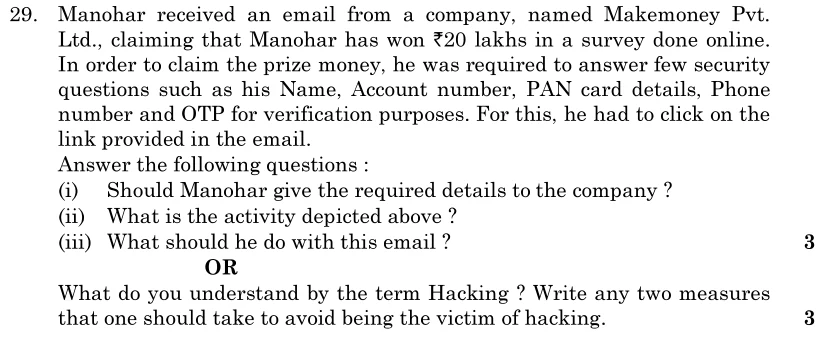
(i) No – he must never share account number, PAN, OTP or other personal details.
(ii) Phishing (a fraud e-mail that tricks a person into giving personal/financial information).
(iii) He should not click the link; he should delete the e-mail, mark it as spam/phishing and report it (e.g. at cybercrime.gov.in).
OR: Hacking is gaining unauthorised access to a computer system or network to steal, change or destroy data. Measures: use strong passwords and two-factor authentication; keep the operating system, antivirus and firewall updated; do not open unknown links/attachments; do not use public Wi-Fi for banking.
आगे: अपनी Practical File तैयार करें और Project चुनें।
