📝 Unit 2 Board Questions + Practice
Unit 2 of the 2026-27 syllabus carries 10 marks. Part A has 12 new practice questions with answers (click "Show answer" only after you try). Part B has all 12 questions of Unit 2 from the previous CBSE board papers (2022, 2023, 2026) in their original form – tables, code and internal choices included – each with a worked answer.
1) Read the unit lessons first. 2) Solve Part A in your notebook, then check answers. 3) Attempt Part B paper-wise with a timer – about 1.5 minutes per mark. 4) Mark the questions you got wrong and revise that lesson again.
Part A – Practice questions with answers
Expand RJ45.
Show answer
Registered Jack 45.
Which device regenerates a weak network signal?
Show answer
Repeater.
Which protocol is intended for transferring files between networked computers?
Show answer
FTP (File Transfer Protocol).
Name the five basic components of data communication. What is a protocol?
Show answer
Sender, receiver, message, transmission medium and protocol. A protocol is a set of rules governing communication.
Place ARPANET, NSFNET and the modern Internet in a broad historical development sequence. State one purpose of computer networking.
Show answer
ARPANET, then NSFNET, then the expanded modern Internet ecosystem; resource sharing or communication. This is a simplified sequence, not a claim that the systems never overlapped.
Differentiate circuit switching and packet switching. A 24 megabit file is transferred at a constant 6 megabits per second with no overhead; calculate the time. Distinguish capacity from achieved transfer rate.
Show answer
Circuit switching reserves a dedicated path; packet switching sends packets through shared links. Time=24/6=4 seconds. Capacity is the link limit; achieved rate is actual data transferred per second.
Name one suitable medium for each: (i) short copper LAN link, (ii) long high-capacity backbone immune to electromagnetic interference, (iii) TV remote, (iv) FM broadcast. Also state one use each of coaxial cable and microwaves.
Show answer
Twisted pair; optical fibre; infrared; radio waves. Coaxial: cable-TV/broadband distribution. Microwaves: directional terrestrial or satellite links.
Classify phone-earbud connection, one school lab, a city-wide network and a link between India and Australia as PAN/LAN/MAN/WAN. State what an IP address identifies.
Show answer
PAN; LAN; MAN; WAN. An IP address identifies an interface/connection at the Internet Protocol layer for addressing and routing.
Differentiate hub, switch and router. State the role of an Ethernet/Wi-Fi card and a gateway.
Show answer
Hub repeats traffic to its other ports; switch forwards frames using learned link-layer addresses; router forwards packets between networks. Network cards provide wired/wireless connectivity; a gateway connects networks/systems and may translate protocols.
Match functions to protocols: web transfer, encrypted web transfer, sending email, retrieving email, point-to-point link communication, remote text login, Internet protocol suite, voice over Internet. Expand HTML and XML.
Show answer
HTTP; HTTPS; SMTP; POP3; PPP; TELNET; TCP/IP; VoIP. HTML: HyperText Markup Language; XML: Extensible Markup Language. TELNET is the syllabus example of unencrypted remote terminal access.
For https://portal.example.org/results/index.html identify the protocol, domain/host and path. Distinguish website, web browser, web server and hosting; expand WWW.
Show answer
https; portal.example.org; /results/index.html. Website: related web pages/resources; browser: client for requesting/displaying them; web server: serves resources; hosting: making a site available on a server. WWW: World Wide Web.
| Link | Distance |
|---|---|
| Admin–Lab | 40 m |
| Admin–Library | 70 m |
| Admin–Sports | 150 m |
| Lab–Library | 35 m |
| Lab–Sports | 90 m |
| Library–Sports | 80 m |
Computers: Admin 25, Lab 120, Library 40, Sports 15. Another campus is 500 km away. Assume a 100 m limit for each copper cable segment.
(i) Choose the server block using the computer counts. (ii) Draw a star with Lab at its centre and state all links. (iii) Name the device connecting computers within each block. (iv) Classify the 500 km connection. (v) Explain whether this star needs a repeater; then state how to handle a separate direct 150 m Admin-Sports copper link. Briefly identify bus and tree topologies as alternative structures.
Show answer
Lab; Lab-Admin, Lab-Library, Lab-Sports; switches; WAN. Star links are all under 100 m, so no repeater is needed solely for those lengths. The separate 150 m copper link needs regeneration with segments within the limit, or a suitable alternative medium. Bus: shared backbone; tree: hierarchical branches.
Part B – Previous year board questions (Unit 2)
CBSE Board Paper 2026 – 5 questions
Show answer
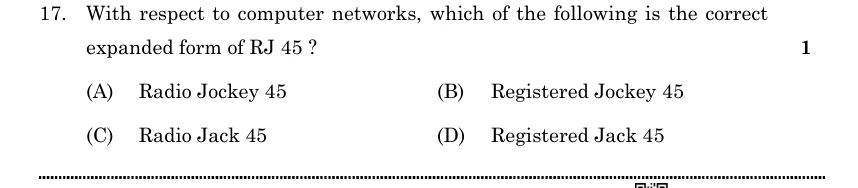
(D) Registered Jack 45
Show answer
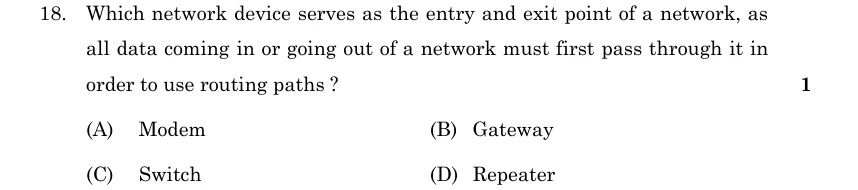
(B) Gateway
Show answer
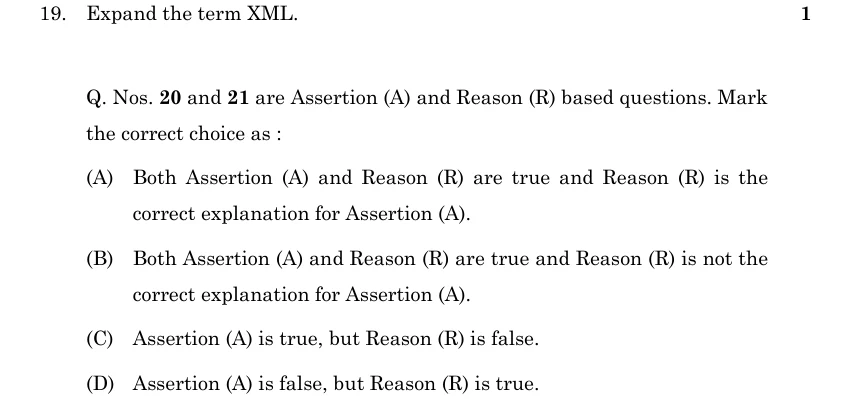
XML – eXtensible Markup Language
Show answer
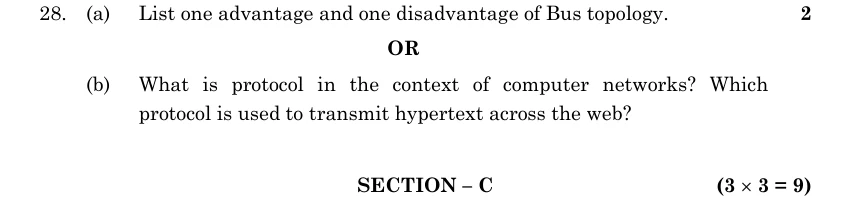
(a) Advantage: needs the least cable and is easy to install/extend. Disadvantage: if the backbone cable fails, the whole network stops (and faults are hard to locate).
OR (b) A protocol is a set of rules that decides how data is formatted, transmitted and received between devices in a network. HTTP (HyperText Transfer Protocol) – or HTTPS for secure transfer – is used to transmit hypertext across the web.

Show answer
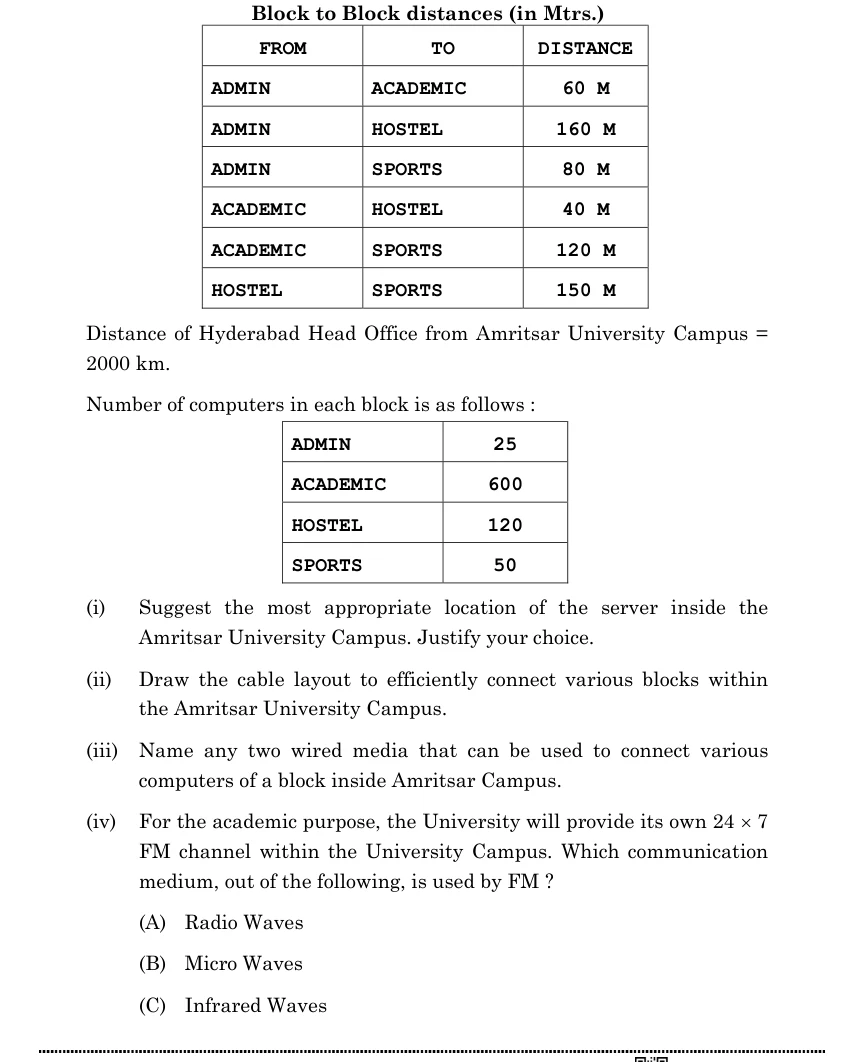
(i) ACADEMIC block – it has the maximum number of computers (600), so most traffic stays local.
(ii) Star layout with ACADEMIC at the centre: ACADEMIC–ADMIN (60 m), ACADEMIC–HOSTEL (40 m), ACADEMIC–SPORTS (120 m).
(iii) Twisted pair (Ethernet) cable and optical fibre cable (coaxial cable also correct).
(iv) (A) Radio Waves
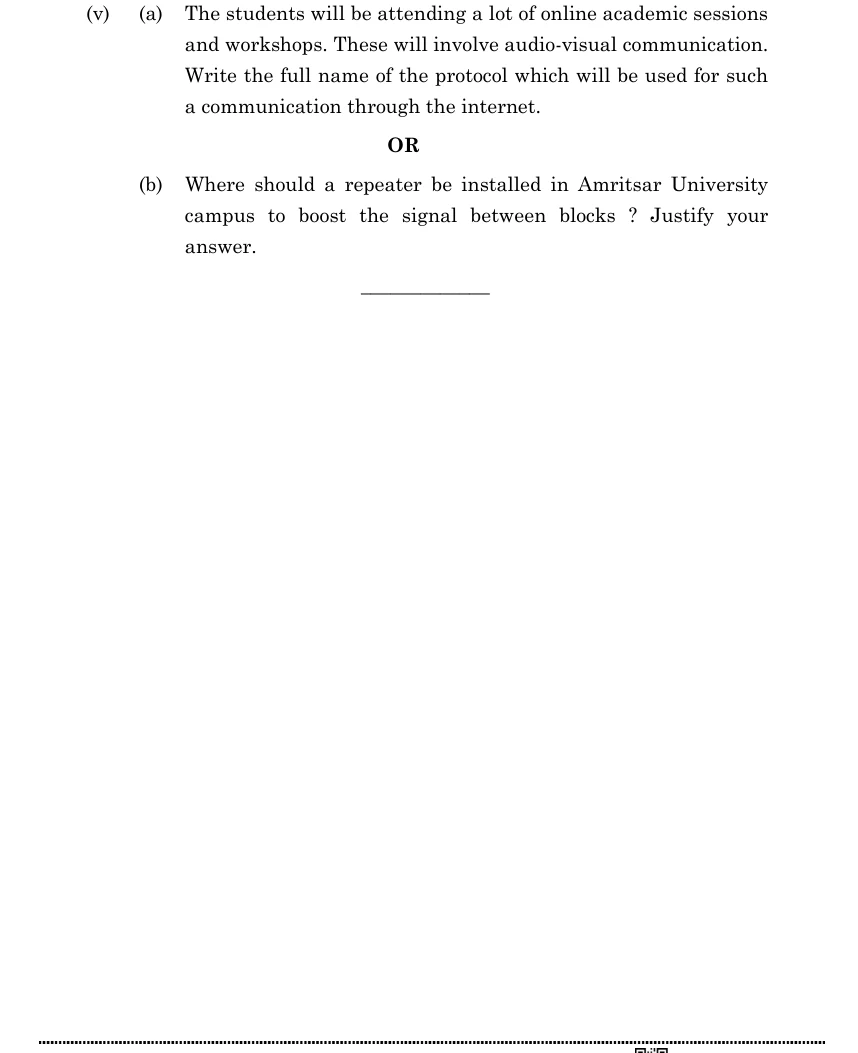
(v) (a) VoIP – Voice over Internet Protocol. OR (b) Between ACADEMIC and SPORTS, because this cable is 120 m (more than 100 m), so the signal becomes weak.
CBSE Board Paper 2023 – 4 questions

Show answer
(c) MICROWAVES

Show answer
(a) Wired transmission sends data through physical cables (twisted pair, coaxial, optical fibre); it is faster, more secure and less affected by interference but devices cannot move freely. Wireless transmission uses radio waves, microwaves or infrared through the air; it allows mobility and easy setup but is more prone to interference and security risks.
OR (b) A URL is the complete address of a resource on the web, e.g. https://www.cbse.gov.in/index.html. A domain name is only the name of the website (the host part) inside the URL, e.g. cbse.gov.in.

Show answer
(a) (i) HyperText Markup Language (ii) Transmission Control Protocol. (b) Protocols are a set of agreed rules for communication. They are needed so that different devices (made by different companies, running different software) can send, receive and understand data correctly – deciding data format, addressing, error checking and the order of transfer.
Show answer
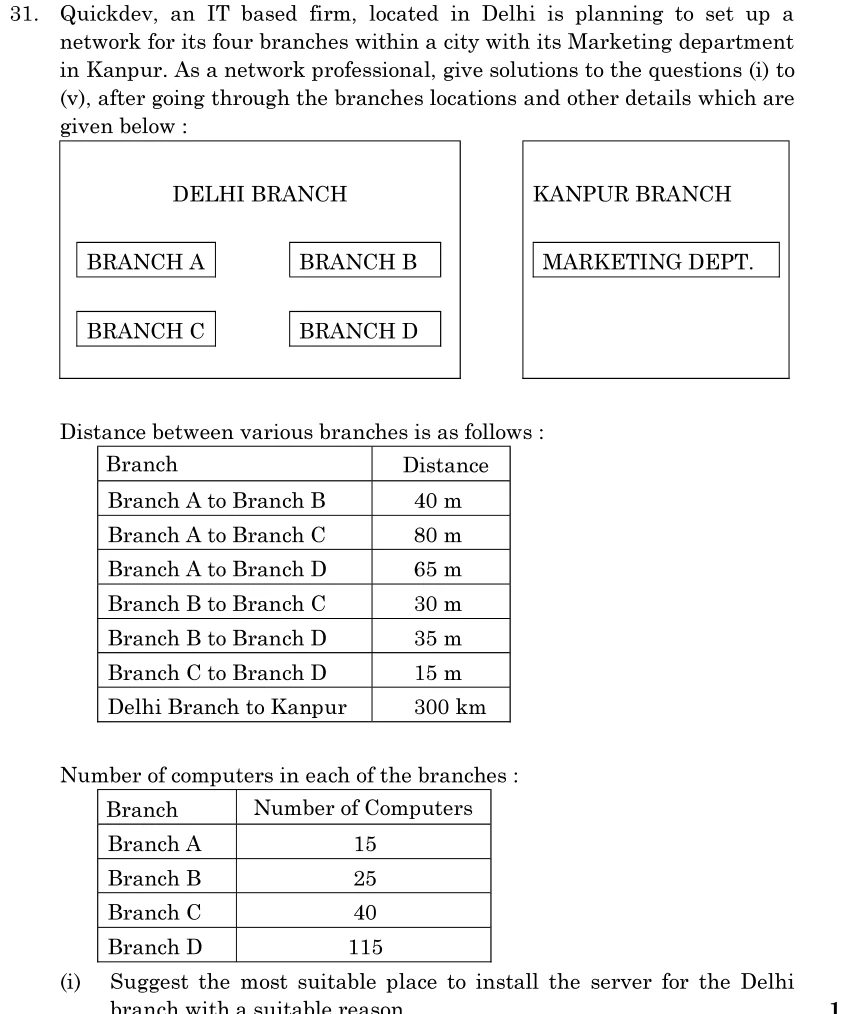
(i) Branch D – it has the maximum number of computers (115), so most traffic stays local.
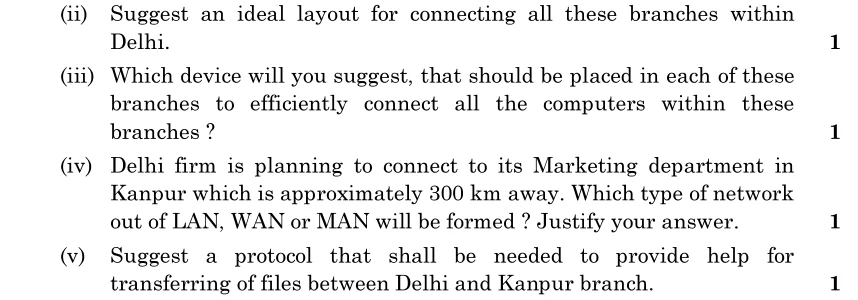
(ii) Star layout with Branch D at the centre: D–A (65 m), D–B (35 m), D–C (15 m).
(iii) Switch (or hub) in each branch.
(iv) WAN – Delhi to Kanpur is about 300 km, between two different cities (beyond the range of a MAN).
(v) FTP (File Transfer Protocol).
CBSE Board Paper 2022 (Term-2, 35 marks) – 3 questions
Show answer
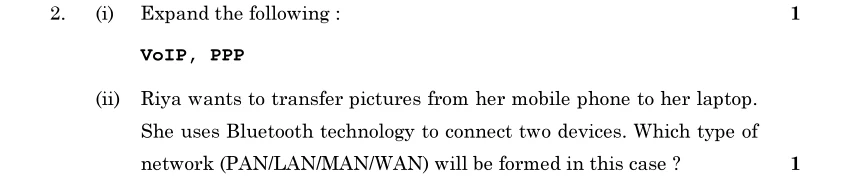
(i) VoIP – Voice over Internet Protocol; PPP – Point-to-Point Protocol. (ii) PAN (Personal Area Network).

Show answer
(i) Bus: all nodes are connected to a single backbone cable. Advantage – needs least cable, easy to install. Tree: a hierarchy of star networks connected to a backbone (branches). Advantage – easy to expand and manage in groups; failure of one branch does not stop the others.
OR: HTML (HyperText Markup Language) is used to display data and design web pages; it has predefined tags and is not case-sensitive. XML (eXtensible Markup Language) is used to store and transport data; tags are user-defined and it is case-sensitive.
(ii) A web browser is client software that requests web pages from a web server and displays them, e.g. Google Chrome, Mozilla Firefox (also Microsoft Edge, Safari).

Show answer
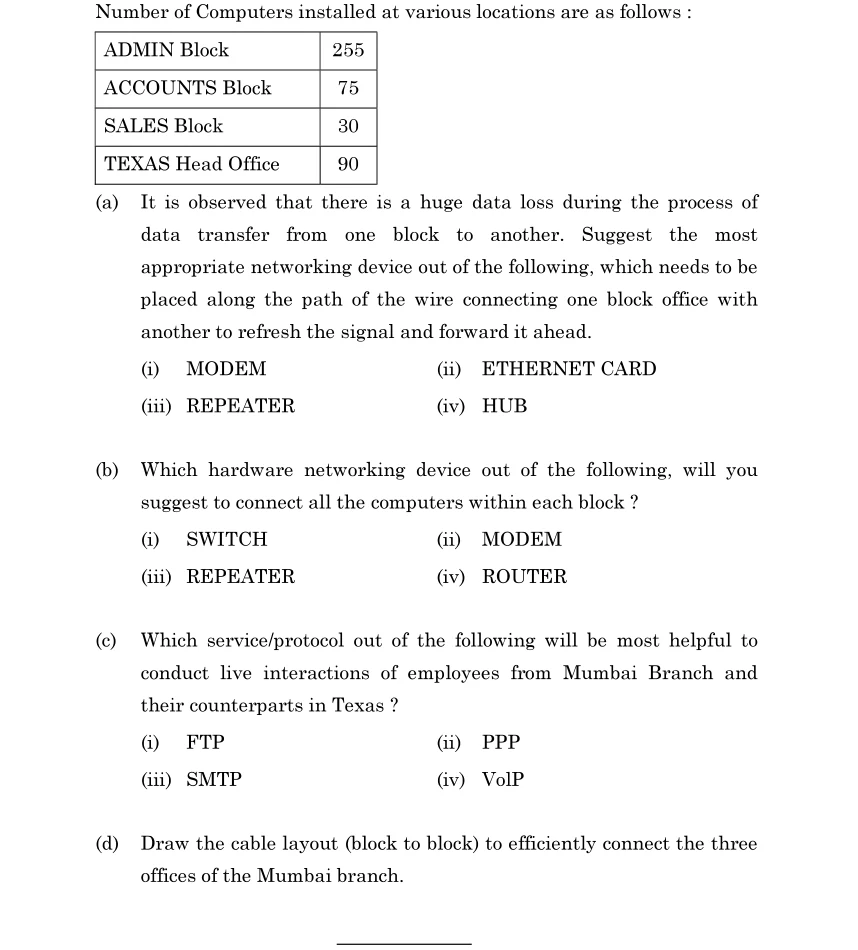
(a) (iii) REPEATER (b) (i) SWITCH (c) (iv) VoIP
(d) Connect ADMIN–SALES (300 m) and SALES–ACCOUNTS (175 m). This uses the least cable (475 m). (A star with ADMIN – which has the most computers, 255 – at the centre, ADMIN–SALES and ADMIN–ACCOUNTS, is also accepted.)
Next: Unit 3 – DBMS, Relational Model & Keys.
