📝 Unit 1 Board Questions + Practice
Unit 1 of the 2026-27 syllabus carries 40 marks. Part A has 36 new practice questions with answers (click "Show answer" only after you try). Part B has all 47 questions of Unit 1 from the previous CBSE board papers (2022, 2023, 2026) in their original form – tables, code and internal choices included – each with a worked answer.
1) Read the unit lessons first. 2) Solve Part A in your notebook, then check answers. 3) Attempt Part B paper-wise with a timer – about 1.5 minutes per mark. 4) Mark the questions you got wrong and revise that lesson again.
Part A – Practice questions with answers
State the types of 42 and 42.0. Are the types identical?
Show answer
int and float; the types differ.
Evaluate: 7 + 12 // 5 * 2 - 9 % 4
Show answer
10.
Predict both outputs.
print('sCHOOL cODE'.capitalize())
print('book:file:read'.partition(':'))
Show answer
School code; ('book', ':', 'file:read').
Predict the output.
print('COMPUTER'[-1:1:-2])Show answer
RTP.
Which operation is invalid for t=(4,8,12)? (A) t[1] (B) t[1:] (C) t.append(16) (D) len(t)
Show answer
C; tuples have no append method.
Predict the result.
d = {'A':10, 'B':20, 'A':30}
print(len(d), d['A'])
Show answer
2 30.
For L=[2,4,6], which raises IndexError: L.pop(2), L.pop(3), L.insert(3,8), or L.append(8)? Treat each independently.
Show answer
L.pop(3).
Name the file mode that appends binary records without truncating existing contents.
Show answer
ab.
Predict the exact output, including the printed return value.
def add(a, b=4):
    print(a+b, end='#')
x = add(3)
print(x)
Show answer
7#None.
Predict the two lines of output.
x = 10
def f():
    x = 3
    print(x)
f()
print(x)
Show answer
3 then 10. Assignment inside f creates a local x.
Predict the final output and explain why the list and integer behave differently.
def change(items, n):
    items.append(9)
    n += 1
L = [1,2]
a = 5
change(L,a)
print(L,a)
Show answer
[1, 2, 9] 5. The list object is mutated; n is locally rebound.
Define total(price, qty=2) to return price*qty. Show calls using the default quantity and a positional quantity of 5.
Show answer
Function and calls:
def total(price, qty=2):
    return price * qty
print(total(100))
print(total(100,5))For d={"R1":80}, use a dictionary method to add R2:75 only if absent, then retrieve R3 with fallback value 0.
Show answer
d.setdefault('R2',75)
d.get('R3',0)Write statements to create a sorted copy of L=[8,3,6] without modifying L, then add the individual elements 10 and 12 to L.
Show answer
new=sorted(L)
L.extend([10,12])
Give all possible values of x and the number of loop iterations. Can the code print 40?
import random
L = [10,20,30,40]
for i in range(3):
    x = random.randrange(1,3)
    print(L[x], end=' ')
Show answer
x is 1 or 2; three iterations; outputs are 20 or 30, never 40.
Correct the function so that it returns the number of uppercase characters.
def count_upper(s)
    n = 0
    for ch in range(s):
        if ch.isupper:
            n =+ 1
    return ch
Show answer
Corrected function:
def count_upper(s):
    n = 0
    for ch in s:
        if ch.isupper():
            n += 1
return nPredict the output and name the handled exception.
try:
    print(12//0)
except ZeroDivisionError:
    print('Invalid division')
finally:
    print('Finished')
Show answer
Invalid division, then Finished. ZeroDivisionError is handled.
Show one built-in function, one function imported from a module and one user-defined function. Give a valid import and call for the module function.
Show answer
Examples: len([1,2]); from math import sqrt followed by sqrt(81); a user-defined total(price,qty) function.
Define adjust(L) to increase each even integer by 2 and decrease each odd integer by 2, modifying L in place. State the result for [4,7,10,13].
Show answer
Result [6,5,12,11].
def adjust(L):
    for i in range(len(L)):
        if L[i] % 2 == 0:
            L[i] += 2
        else:
L[i] -= 2Define frequency(text) to return a dictionary counting each character, ignoring spaces and letter case. State the result for "A aB".
Show answer
{'a':2,'b':1}
def frequency(text):
    counts = {}
    for ch in text.lower():
        if ch != ' ':
            counts[ch] = counts.get(ch,0) + 1
return countsDefine count_digits(filename) to count and return digit characters in a text file. For text "Lab 12 has 8 PCs", the result must be 3.
Show answer
One valid solution:
def count_digits(filename):
    count = 0
    with open(filename,'r',encoding='utf-8') as f:
        for ch in f.read():
            if ch.isdigit():
                count += 1
return countDefine show_lines(filename) to display only lines with at least 6 whitespace-separated words, without inserting extra blank lines.
Show answer
One valid solution:
def show_lines(filename):
    with open(filename,'r',encoding='utf-8') as f:
        for line in f:
            if len(line.split()) >= 6:
print(line,end='')Define copy_clean(source,target) to copy only lines that do not contain the letter a in either case. The source and target are different files.
Show answer
One valid solution:
def copy_clean(source,target):
    with open(source,'r',encoding='utf-8') as src:
        with open(target,'w',encoding='utf-8') as dst:
            for line in src:
                if 'a' not in line.lower():
dst.write(line)Assume data.bin contains exactly the ASCII bytes ABCDEFG. Predict all four outputs.
with open('data.bin','rb') as f:
    print(f.read(2))
    print(f.tell())
    f.seek(1)
    print(f.read(3))
    print(f.tell())
Show answer
b'AB'; 2; b'BCD'; 4.
Differentiate r, w and a for text files. Explain relative versus absolute paths with examples.
Show answer
r reads and requires an existing file; w writes and truncates/creates; a appends/creates. Relative path: data/marks.txt from the current working directory. Absolute path: /school/data/marks.txt on a Unix-like system.
Define push_merit(records,stack). Each record is [Name,Marks]. Push the names having Marks >= 85, preserving input order. For [["Asha",90],["Bilal",78],["Charu",88]], an initially empty stack becomes ["Asha","Charu"].
Show answer
One valid solution:
def push_merit(records,stack):
    for name,marks in records:
        if marks >= 85:
stack.append(name)Define pop_one(stack) to return the top item, or print UNDERFLOW and return None if empty. Define display(stack) to print items top-first without changing the stack.
Show answer
One valid solution:
def pop_one(stack):
    if not stack:
        print('UNDERFLOW')
        return None
    return stack.pop()

def display(stack):
    for item in stack[::-1]:
print(item)Create books.csv with header BookID,Title,Price and records [101,"Python",450], [102,"SQL",380]. Use csv.writer and writerows. Include file closure.
Show answer
One valid solution:
import csv
with open('books.csv','w',newline='',encoding='utf-8') as f:
    w = csv.writer(f)
    w.writerow(['BookID','Title','Price'])
w.writerows([[101,'Python',450],[102,'SQL',380]])Read books.csv from U1-28 and append only records with Price >= 400 to costly.csv. Do not copy the header. Convert the CSV price field to a number before comparing.
Show answer
One valid solution:
import csv
with open('books.csv','r',newline='',encoding='utf-8') as src:
    with open('costly.csv','a',newline='',encoding='utf-8') as dst:
        rows = csv.reader(src)
        next(rows,None)
        w = csv.writer(dst)
        for row in rows:
            if row and float(row[2]) >= 400:
w.writerow(row)Define append_student(filename,roll,name,marks) to append the list [roll,name,marks] as one pickled record to a binary file. Define create_empty(filename) to create/truncate a binary file.
Show answer
One valid solution:
import pickle
def append_student(filename,roll,name,marks):
    with open(filename,'ab') as f:
        pickle.dump([roll,name,marks],f)

def create_empty(filename):
    with open(filename,'wb'):
passA trusted binary file stores consecutive pickled [roll,name,marks] records with unique rolls. Define find_student(filename,target) to return the matching record, or None if absent. Handle normal end-of-file.
Show answer
One valid solution:
import pickle
def find_student(filename,target):
    with open(filename,'rb') as f:
        while True:
            try:
                rec = pickle.load(f)
            except EOFError:
                return None
            if rec[0] == target:
return recFor the file format in U1-31, define update_marks(filename,target,newmarks) to update the matching unique roll, preserving all other records. Return True if found, else False. Read records before reopening for writing.
Show answer
A read-then-rewrite solution avoids assuming equal pickle record sizes:
import pickle
def update_marks(filename,target,newmarks):
    records = []
    found = False
    with open(filename,'rb') as f:
        while True:
            try:
                rec = pickle.load(f)
            except EOFError:
                break
            if rec[0] == target:
                rec[2] = newmarks
                found = True
            records.append(rec)
    if found:
        with open(filename,'wb') as f:
            for rec in records:
                pickle.dump(rec,f)
return foundDefine count_pass(filename) for the same binary format to count records with marks >= 33. Handle normal EOF and return the count.
Show answer
One valid solution:
import pickle
def count_pass(filename):
    count = 0
    with open(filename,'rb') as f:
        while True:
            try:
                rec = pickle.load(f)
            except EOFError:
                break
            if rec[2] >= 33:
                count += 1
return countTrace the function and write its output.
def build(s):
    result = []
    for ch in s:
        if ch.isdigit():
            result.reverse()
        elif ch not in result:
            result.append(ch)
    return ''.join(result)
print(build('ab2ac3'))
Show answer
cab.
Write a program that reads two integer inputs and prints their quotient. Handle non-integer input and division by zero separately. Always print Done using finally.
Show answer
One valid solution:
try:
    a = int(input('First integer: '))
    b = int(input('Second integer: '))
    print(a/b)
except ValueError:
    print('Enter integers only')
except ZeroDivisionError:
    print('Divisor cannot be zero')
finally:
print('Done')For a text file, distinguish read(), readline() and readlines(). Explain what writelines() does with ["Red","Blue"] and why a with block is useful.
Show answer
read() returns remaining text; readline() reads one line; readlines() returns remaining lines as a list. writelines(['Red','Blue']) writes RedBlue, adding no separators. A with block closes the file on exit, including when an exception occurs.
Part B – Previous year board questions (Unit 1)
CBSE Board Paper 2026 – 22 questions

Show answer
False – 74 is int and 74.0 is float.

Show answer
(A) The truth

Show answer
(C) 3>1 and 3>2 – it gives True. (B) gives 2, not True.
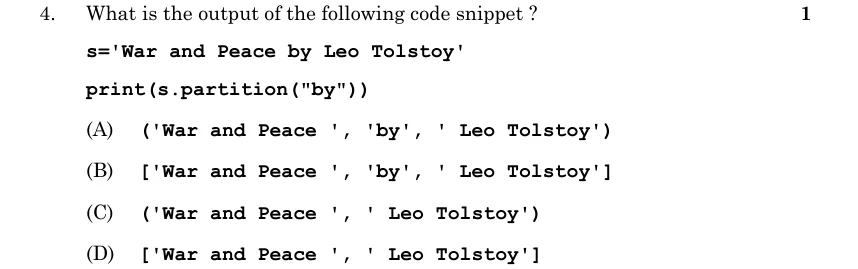
Show answer
(A) ('War and Peace ', 'by', ' Leo Tolstoy')

Show answer
mroPo
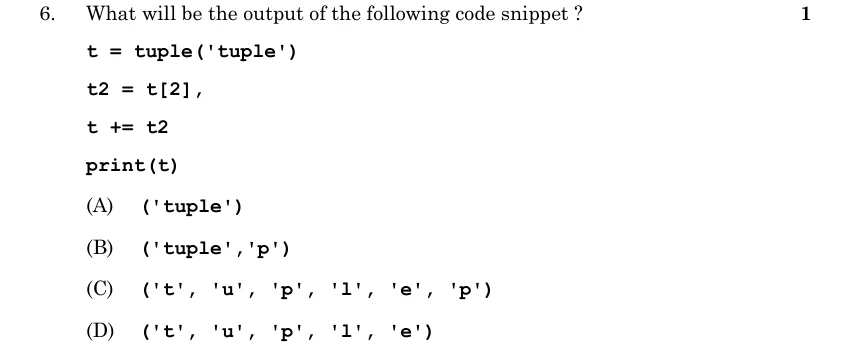
Show answer
(C) ('t', 'u', 'p', 'l', 'e', 'p') – t2 = t[2], is a one-element tuple ('p',).
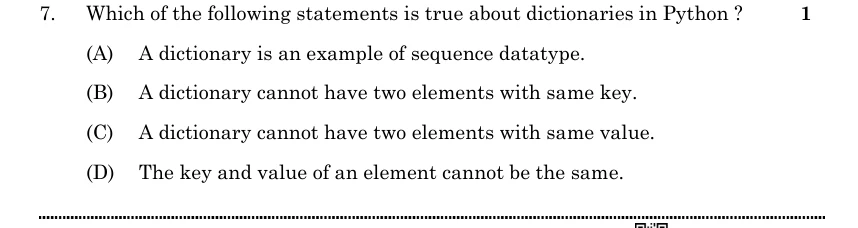
Show answer
(B) A dictionary cannot have two elements with same key.

Show answer
(B) L.pop(6) – valid indexes are 0 to 5, so IndexError. (insert never raises IndexError.)
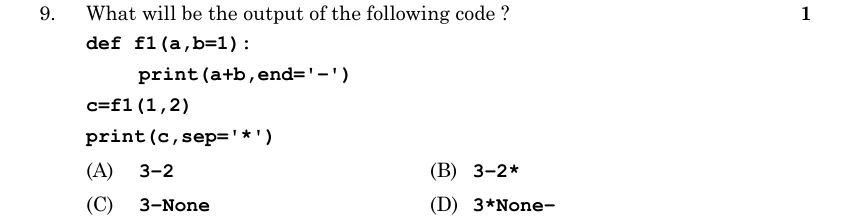
Show answer
(C) 3-None – f1 prints 3- and returns None, which is then printed.
Show answer
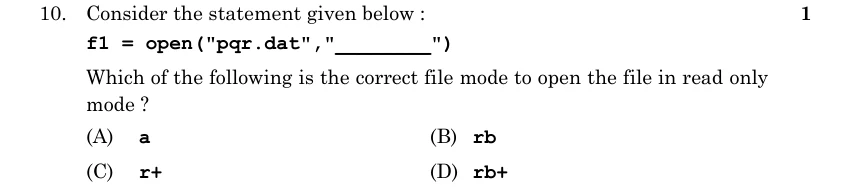
(B) rb

Show answer
False – try-except handles run-time errors (exceptions), not logical errors.

Show answer
(A) – both are true and the reason explains the assertion (TypeError: can only concatenate list to list).

Show answer
Positional parameters get values according to their position in the call and must be given. Default parameters have a value in the function header, which is used when no argument is passed; they must come after the positional (non-default) parameters.
def bill(price, qty=1):     # price: positional, qty: default
    return price * qty
Show answer
L1 = sorted(L)       # (i)
ch.isalnum()         # (ii) True if ch is an alphabet or a digit

Show answer
(i) (a) 'RNo' in D1 OR (b) 12 in D1.values()
(ii) (a) D1.setdefault('RNo', 12) OR (b) D1.clear()
Show answer
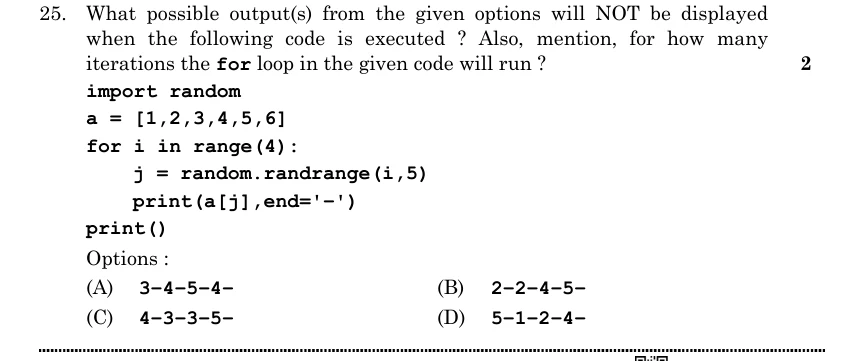
Option (D) 5-1-2-4- can NOT be displayed. The loop runs 4 times (i = 0, 1, 2, 3).
In the 2nd iteration j = randrange(1,5) is 1 to 4, so a[j] is 2 to 5 – it can never be 1. Options A, B and C are possible.
Show answer
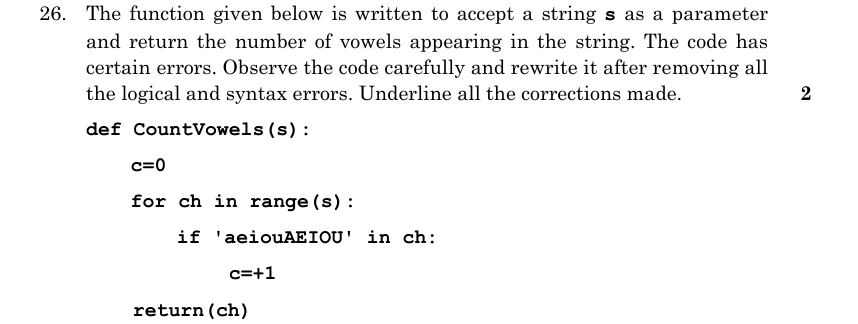
Corrections: iterate over s (not range(s)), test ch in 'aeiouAEIOU', c += 1, return c.
def CountVowels(s):
    c = 0
    for ch in s:
        if ch in 'aeiouAEIOU':
            c += 1
    return c
Show answer
(a)
def count_digits():
    count = 0
    with open('Space.txt', 'r') as f:
        for ch in f.read():
            if ch.isdigit():
                count += 1
    return count
OR (b)
def show_e_words():
    with open('Space.txt', 'r') as f:
        for word in f.read().split():
            if word.count('e') >= 2:
                print(word, end=' ')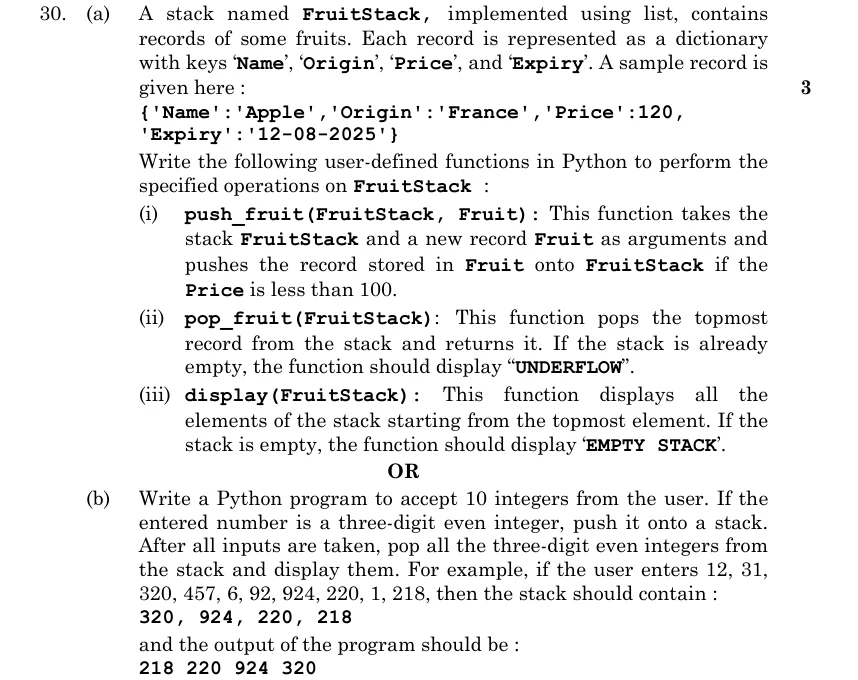
Show answer
(a)
def push_fruit(FruitStack, Fruit):
    if Fruit['Price'] < 100:
        FruitStack.append(Fruit)

def pop_fruit(FruitStack):
    if FruitStack == []:
        print("UNDERFLOW")
        return None
    return FruitStack.pop()

def display(FruitStack):
    if FruitStack == []:
        print("EMPTY STACK")
    else:
        for rec in FruitStack[::-1]:
            print(rec)
OR (b)
stack = []
for i in range(10):
    n = int(input("Enter an integer: "))
    if 100 <= abs(n) <= 999 and n % 2 == 0:
        stack.append(n)
while stack:
    print(stack.pop(), end=' ')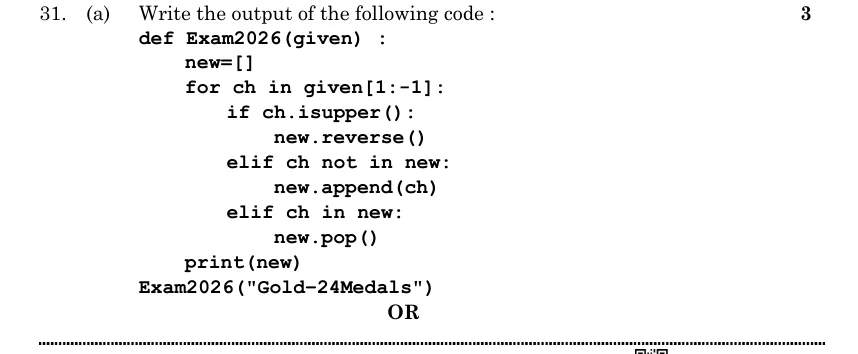
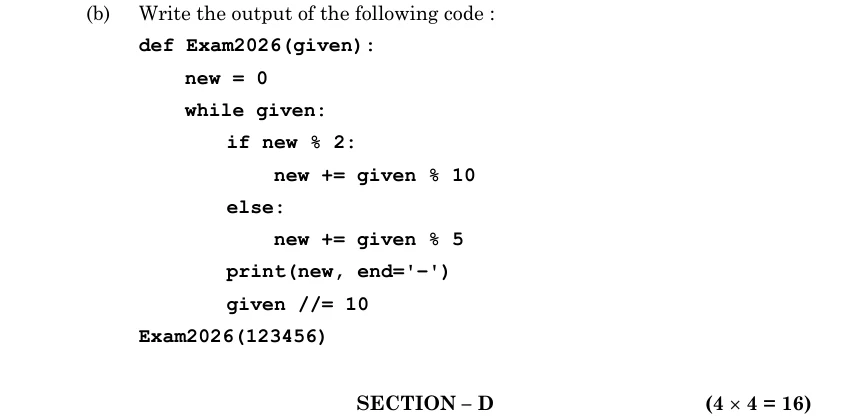
Show answer
(a)
['4', '2', '-', 'd', 'l', 'o']
OR (b)
1-6-10-13-15-16-
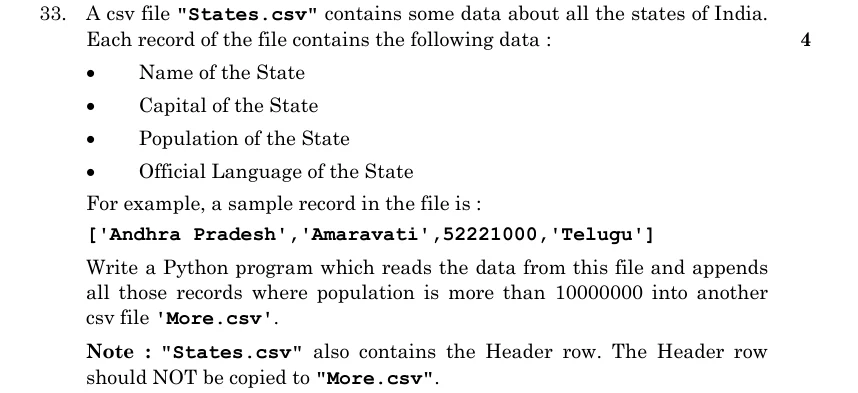
Show answer
import csv
with open('States.csv', 'r', newline='') as fin, open('More.csv', 'a', newline='') as fout:
    reader = csv.reader(fin)
    writer = csv.writer(fout)
    next(reader)                      # skip the header row
    for rec in reader:
        if int(rec[2]) > 10000000:
            writer.writerow(rec)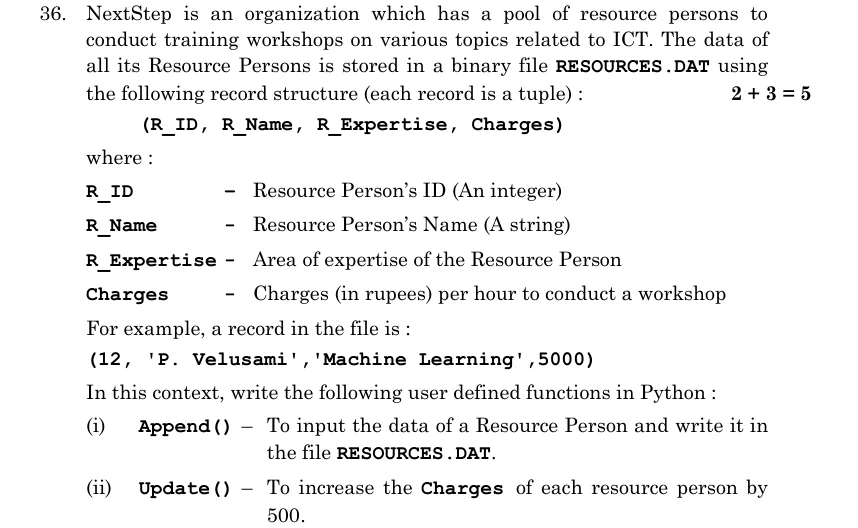
Show answer
import pickle

def Append():
    rid = int(input("Resource person ID: "))
    name = input("Name: ")
    exp = input("Expertise: ")
    charges = int(input("Charges per hour: "))
    with open('RESOURCES.DAT', 'ab') as f:
        pickle.dump((rid, name, exp, charges), f)

def Update():
    records = []
    with open('RESOURCES.DAT', 'rb') as f:
        while True:
            try:
                records.append(pickle.load(f))
            except EOFError:
                break
    with open('RESOURCES.DAT', 'wb') as f:
        for r in records:            # tuples are immutable, so make a new tuple
            pickle.dump((r[0], r[1], r[2], r[3] + 500), f)
CBSE Board Paper 2023 – 23 questions

Show answer
True

Show answer
(b) return

Show answer
(b) Tup.insert(2,3) – a tuple is immutable and has no insert() method.

Show answer
(a) True
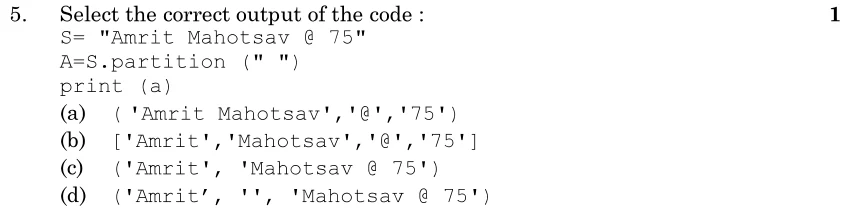
Show answer
(d) – partition(' ') splits at the first space: ('Amrit', ' ', 'Mahotsav @ 75'). The middle element is the separator (a space).

Show answer
(d) a

Show answer
(a) sort()

Show answer
(b) !=
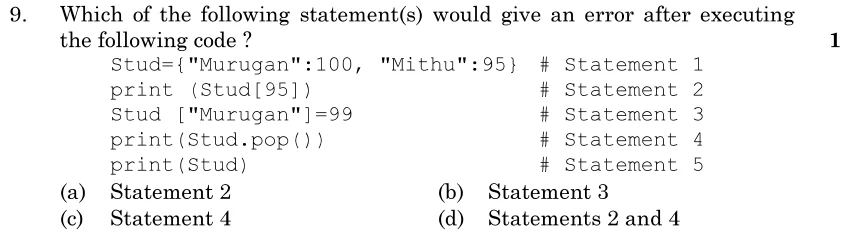
Show answer
(d) Statements 2 and 4 – Stud[95] raises KeyError (95 is a value, not a key) and dict.pop() needs a key argument.

Show answer
(a) 0 (beginning of the file)

Show answer
(b) 8.0 – 3*5/3 = 5.0, 5%2 = 1, so 4 + 5.0 - 1 = 8.0

Show answer
(b) sum()

Show answer
(b) – both are true, but the reason (where import can be written) is not the explanation of why we must import.

Show answer
(a) – both are true and the reason explains LIFO: a new element always goes on top (after the last element), so it is the first to be removed.
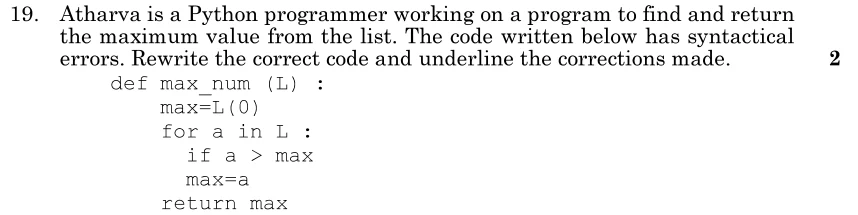
Show answer
Corrections: L[0] instead of L(0), colon after if, indentation of max=a.
def max_num(L):
    max = L[0]
    for a in L:
        if a > max:
            max = a
    return max
Show answer
(a) ['Rajat', 'Rajan', 'Ashish'] (b) 1
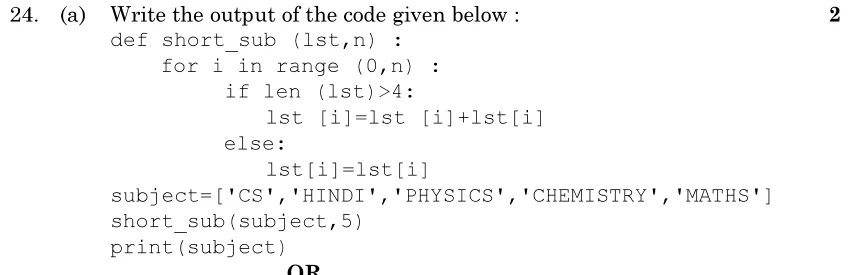

Show answer
(a)
['CSCS', 'HINDIHINDI', 'PHYSICSPHYSICS', 'CHEMISTRYCHEMISTRY', 'MATHSMATHS']
OR (b) a = 30 is even, so x += a each time: 35+30 = 65 and 40+30 = 70.
65#70@
Show answer
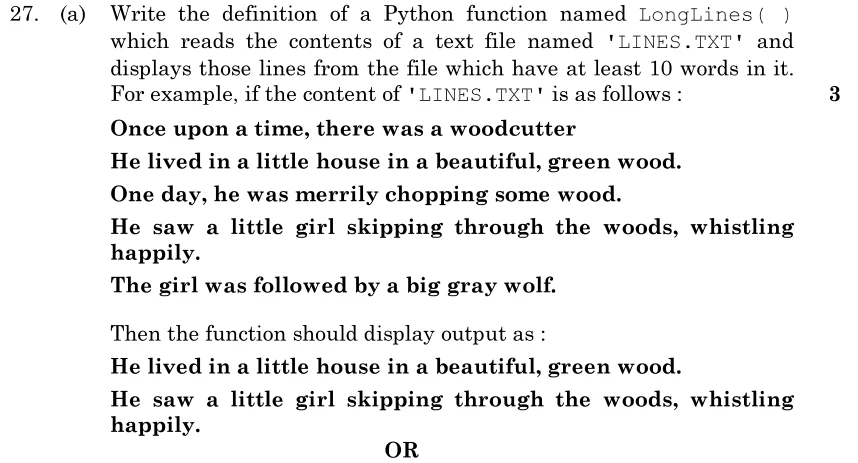
(a)
def LongLines():
    with open('LINES.TXT', 'r') as f:
        for line in f:
            if len(line.split()) >= 10:
                print(line, end='')
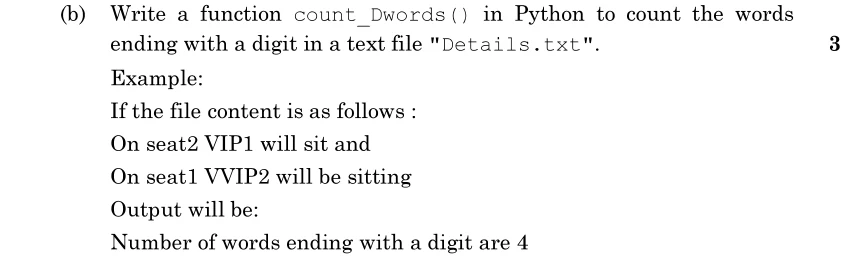
OR (b)
def count_Dwords():
    count = 0
    with open('Details.txt', 'r') as f:
        for word in f.read().split():
            if word[-1].isdigit():
                count += 1
    print("Number of words ending with a digit are", count)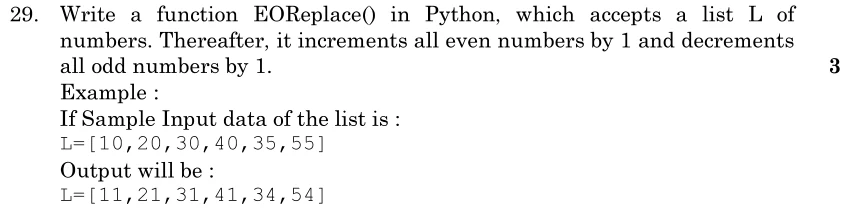
Show answer
def EOReplace(L):
    for i in range(len(L)):
        if L[i] % 2 == 0:
            L[i] = L[i] + 1
        else:
            L[i] = L[i] - 1
    print(L)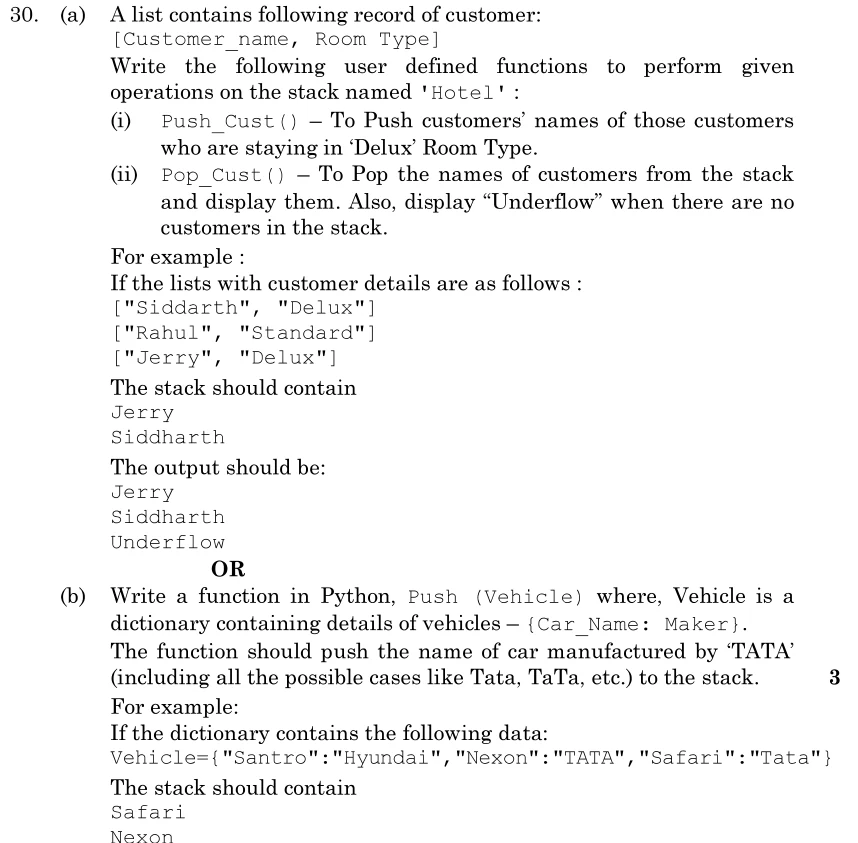
Show answer
(a)
Hotel = []

def Push_Cust(customers):
    for rec in customers:
        if rec[1] == 'Delux':
            Hotel.append(rec[0])

def Pop_Cust():
    while Hotel:
        print(Hotel.pop())
    print("Underflow")
OR (b)
stack = []

def Push(Vehicle):
    for car, maker in Vehicle.items():
        if maker.upper() == 'TATA':
            stack.append(car)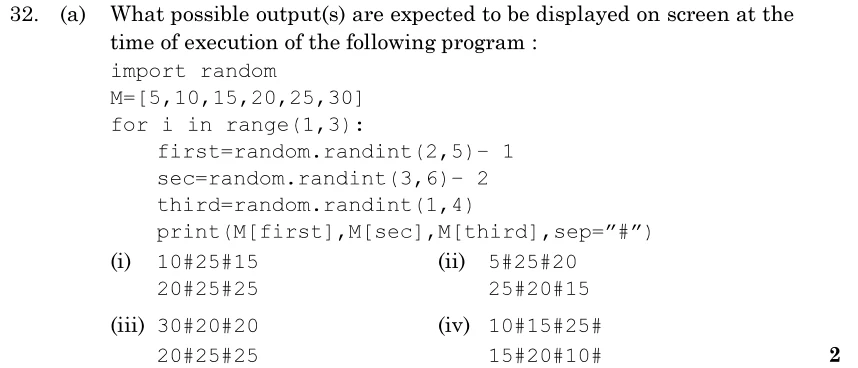

Show answer
Possible output: (i) only.
first = randint(2,5) - 1 gives 1 to 4, sec = randint(3,6) - 2 gives 1 to 4, third = randint(1,4) gives 1 to 4, so every value is M[1]…M[4] = 10, 15, 20 or 25 (never 5 or 30), and sep='#' puts # only between values (no # at the end).
Alternative (a) – makenew("No@1"):
N1@3
(count 0 → 'N'; count 1 → '1'; count 2 → '@'.upper() = '@'; count 3 → '3')

Show answer
(a) A text file stores plain lines of text; a CSV file is a text file in which each line is a record and values are separated by commas (tabular data, opened with the csv module).
import csv

def COURIER_ADD():
    with open('courier.csv', 'a', newline='') as f:
        w = csv.writer(f)
        cid = input("Courier ID: ")
        s_name = input("Sender name: ")
        source = input("Source: ")
        destination = input("Destination: ")
        w.writerow([cid, s_name, source, destination])

def COURIER_SEARCH():
    dest = input("Destination to search: ")
    with open('courier.csv', 'r', newline='') as f:
        for rec in csv.reader(f):
            if rec[3] == dest:
                print(rec)

COURIER_ADD()
COURIER_SEARCH()
OR (b) A file should be closed so that all data in the buffer is written to the disk, the resources are freed and the data is not lost or corrupted.
import csv

def Add_Book():
    with open('Book.csv', 'a', newline='') as f:
        w = csv.writer(f)
        book_ID = input("Book ID: ")
        B_name = input("Book name: ")
        pub = input("Publisher: ")
        w.writerow([book_ID, B_name, pub])

def Search_Book():
    p = input("Publisher name: ")
    count = 0
    with open('Book.csv', 'r', newline='') as f:
        for rec in csv.reader(f):
            if rec[2] == p:
                count += 1
    print("Number of books published by", p, "=", count)

Add_Book()
Search_Book()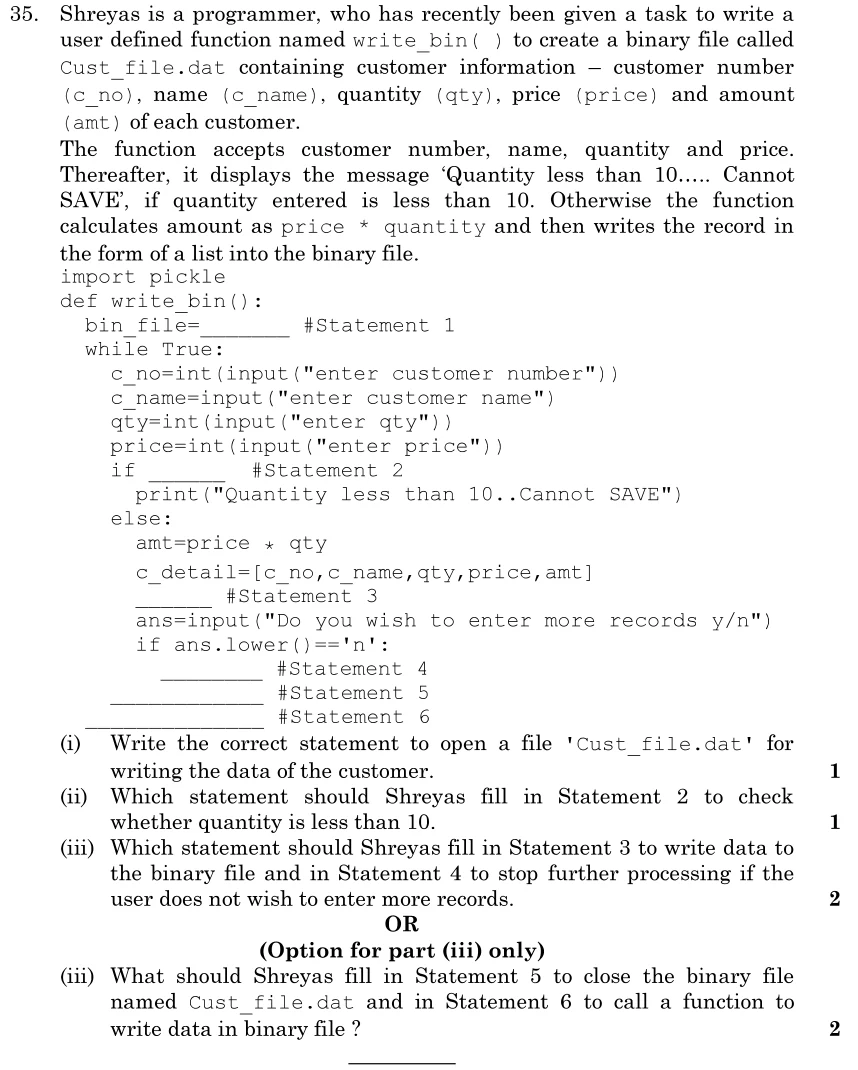
Show answer
(i) Statement 1: bin_file = open('Cust_file.dat', 'wb') (or 'ab' to keep old records)
(ii) Statement 2: if qty < 10:
(iii) Statement 3: pickle.dump(c_detail, bin_file) Statement 4: break
OR (iii) Statement 5: bin_file.close() Statement 6: write_bin()
CBSE Board Paper 2022 (Term-2, 35 marks) – 2 questions
Show answer
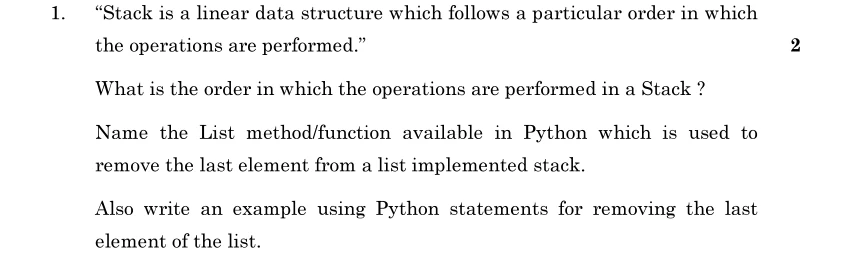
A stack follows LIFO (Last In, First Out) – the element added last is removed first. The list method pop() removes the last element.
stack = [10, 20, 30]
stack.pop()        # removes 30
print(stack)       # [10, 20]

Show answer
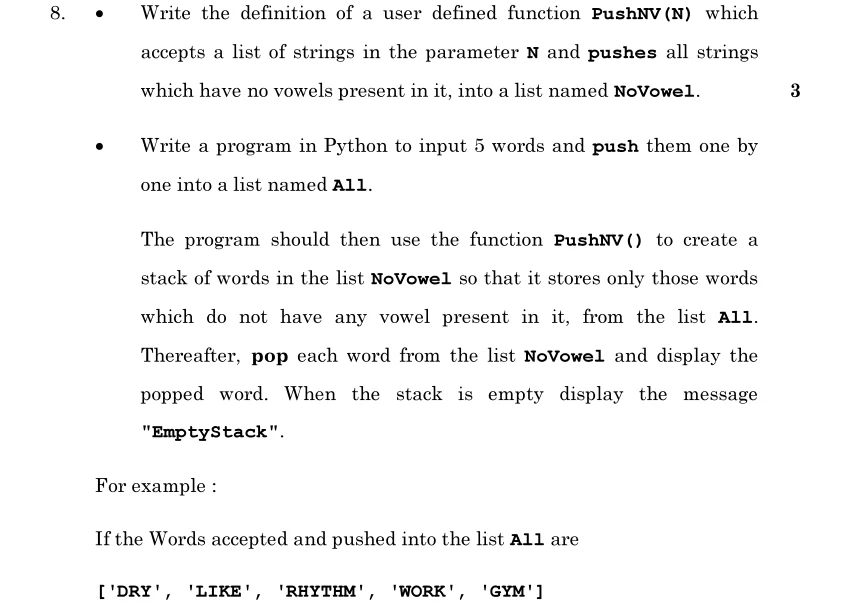
def PushNV(N):
    for word in N:
        for ch in word:
            if ch in 'aeiouAEIOU':
                break
        else:                       # no vowel found
            NoVowel.append(word)

All = []
NoVowel = []
for i in range(5):
    All.append(input("Enter a word: "))
PushNV(All)
while NoVowel:
    print(NoVowel.pop(), end=' ')
print("EmptyStack")
OR
def Push3_5(N):
    for x in N:
        if x % 3 == 0 or x % 5 == 0:
            Only3_5.append(x)

NUM = []
Only3_5 = []
for i in range(5):
    NUM.append(int(input("Enter an integer: ")))
Push3_5(NUM)
while Only3_5:
    print(Only3_5.pop(), end=' ')
print("StackEmpty")Next: Unit 2 – Networks: Evolution & Types.
